Three rules cover most of restraint safety: two fingers must fit under every cuff, the means of release must be within reach at all times, and nothing goes around the neck. Ever. Everything else is refinement.
Restraint play is one of the most popular starting points in BDSM because the equipment is simple and the effect is immediate. It is also where the most avoidable injuries happen, almost all of them from cuffs that were too tight or too thin.
Why are metal handcuffs a bad first choice?
Because they are narrow, hard, and have no give. All the force of a struggling wrist concentrates on a thin band of metal, which compresses the ulnar and radial nerves. The result is numbness and tingling that can persist for weeks. Police-style cuffs also ratchet tighter under movement, which is exactly the wrong behaviour.
Padded leather or neoprene cuffs spread load across a wide, soft band. Our padded leather handcuffs at ₹3,699 are the sensible starting point, and they cost less than an evening out.
How tight is right?
Two fingers, flat, must slide under the cuff comfortably. Check after tightening and check again after ten minutes, because straps settle and wrists swell.
Warning signs to release immediately: fingers or toes going white, blue or cold; numbness or pins and needles that does not pass within a minute of shifting position; any pain at the cuff itself rather than at the joint.
Wrists or ankles — does the fit differ?
Yes. Ankles tolerate more tension than wrists because there is more tissue over the bone, but the same two-finger rule applies. Wrist cuffs sit above the wrist bone, not on it. Ankle cuffs sit above the ankle bone for the same reason.
Behind-the-back positions put far more strain on shoulders than most people expect and should not be held for long. In front, or spread to the bed frame, is easier on the body and easier to monitor. A spreader bar holds a position without loading the shoulders at all, which is why it is gentler than it looks.
What about rope?
Rope is the most versatile restraint and the one with the steepest learning curve, and the two facts are related.
Two things matter more than any tie. Never tie across a joint — wrists yes, but not the wrist crease itself, and never the neck. And never use a knot that tightens under load; a slip knot around a limb is how nerve damage happens, because a struggling person pulls it closed.
Keep safety scissors in reach, use wide flat wraps rather than thin bites, and check circulation every few minutes. If you are learning, cuffs do 90% of what rope does with almost none of the risk — which is why every kit ships with cuffs rather than rope.
What is the fastest way out?
Buckles, not locks, and safety scissors within arm's reach of whoever is not restrained. Blunt-nosed paramedic shears cut webbing, leather and rope without cutting skin, and cost almost nothing.
If anything is locked, the key lives in one agreed place and both people know where. Not in another room. Not in a bag. If you are playing alone, use nothing that cannot be released one-handed by the person wearing it.
How long can someone stay restrained?
Shorter than the fantasy suggests. Twenty to thirty minutes in one position is plenty for a beginner, and circulation should be checked every ten. Positions with arms raised above the head are the most limiting — shoulders fatigue quickly and the person may not notice until it is genuinely sore.
Change position rather than extending time.
What must never be restrained?
The neck. There is no safe way for non-experts to restrict the neck, no reliable way to monitor it, and unconsciousness arrives faster and with less warning than people believe. Collars worn decoratively are fine; anything that applies tension to the neck is not.
Also: never leave a restrained person alone, not for a minute, not to answer the door.
What about kits?
Kits are good value for beginners because they include the pieces you would otherwise buy one at a time and discover you needed. Our 7-piece bondage kit at ₹5,999 covers cuffs, a blindfold and impact toys; the handmade leather set at ₹8,999 is the better-made version of the same idea.
The flogger and plush cuffs set at ₹3,399 is a cheaper way in if you want restraint plus one impact toy, and the same set in pink is identical.
Which pieces actually get used is covered in our kit guide — the short version is cuffs and a blindfold, every time.
Do you need a safeword if nobody is gagged?
Yes. Agree it beforehand, and agree a non-verbal signal too — a dropped object or two clear taps — because restraint changes how easy it is to speak up even without a gag. If gags are involved, the non-verbal signal is mandatory; our mouth gag guide covers that in detail.
What comes after?
Check circulation first, then rub the marked areas gently, and give it a few minutes before anyone stands up quickly — blood pressure drops and people faint more often than they expect after being still and restrained.
Then the part people skip: a real dip in mood can arrive hours or a day later, on both sides, as adrenaline and endorphins clear. Warmth, food, water and company are the standard answer, and knowing it is coming is most of the fix.
Wipe leather cuffs with a barely damp cloth and never soak them — water is what cracks leather. Webbing can be hand-washed. Full routine in cleaning and care.
Where does this go next?
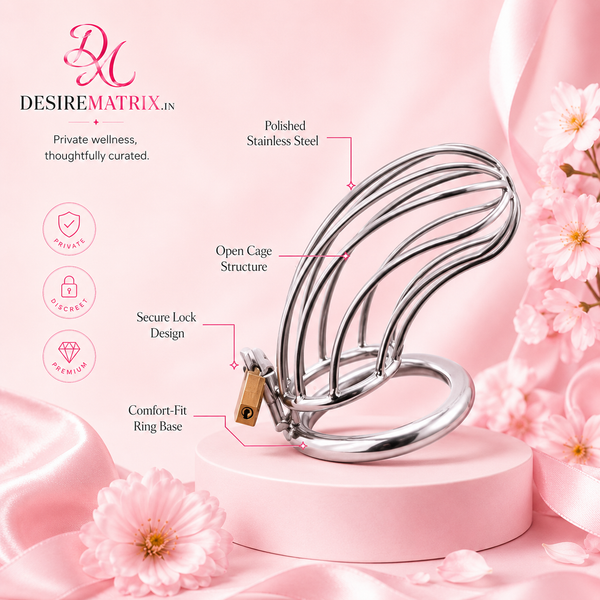
If impact play is the direction, our paddle, flogger or crop guide covers where to start and how hard is too hard. If control rather than sensation is the appeal, chastity is the other branch.
All 42 restraints are in Bondage Restraints & BDSM Kits. Plain, unbranded packaging across India.
 DESIRE